

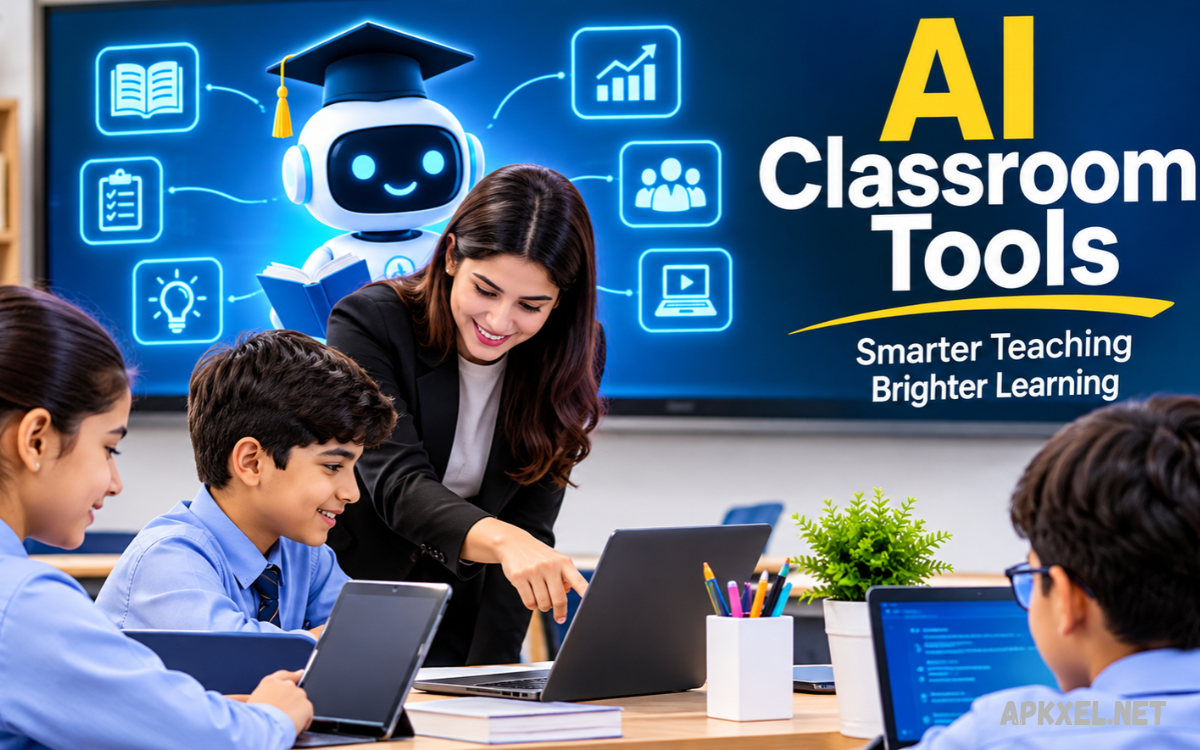
AI Classroom Tools are changing modern education by helping teachers create better lessons, manage classroom activities, and support student learning. Artificial intelligence makes educational tasks easier through automation, personalized learning, and interactive resources.
Modern classrooms need flexible teaching methods, engaging educational content, and efficient learning systems. AI-powered solutions provide useful features for lesson preparation, writing assistance, student assessments, and classroom organization.
What Are AI Classroom Tools?
AI Classroom Tools are digital applications powered by artificial intelligence that support teaching and learning activities. They help educators prepare educational materials, explain difficult concepts, create quizzes, and organize classroom tasks.
These tools use technologies such as machine learning, natural language processing, and generative AI. They can analyze information, generate educational content, and provide learning assistance based on user instructions.
Importance of AI Classroom Tools in Modern Education
Education continues to evolve as technology becomes an important part of everyday learning. AI Classroom Tools help schools introduce modern teaching methods while improving classroom productivity. Teachers can spend less time completing repetitive tasks and more time supporting students.
Artificial intelligence also creates opportunities for interactive learning experiences. Students can explore topics through explanations, practice exercises, and educational activities. These features help make lessons more engaging while supporting different learning preferences and academic needs.
Best Features of AI Classroom Tools
AI-powered classroom applications include several features designed to simplify educational activities. Common features include lesson generation, writing assistance, automatic quiz creation, language support, and personalized learning recommendations. These functions help teachers organize lessons and prepare useful classroom materials.
Some platforms also provide progress tracking, content summarization, and assessment assistance. Teachers can use these features to identify learning gaps and adjust instructional methods. However, generated information should always receive human review to maintain accuracy and educational quality.
AI Tools for Lesson Planning
Lesson planning requires time, organization, and a clear understanding of learning objectives. AI Classroom Tools can help teachers generate lesson outlines, suggest classroom activities, and organize topics according to grade levels. These features make preparation more efficient.
Teachers can provide a subject, topic, and learning objective to receive a suggested lesson structure. They can then customize the material according to classroom requirements. Human review remains essential because AI-generated plans may contain unsuitable examples or incorrect information.
AI Tools for Creating Educational Content
Creating educational content involves preparing explanations, worksheets, presentations, and classroom activities. AI-powered applications can help teachers develop these resources using simple instructions. This makes it easier to create different types of learning materials.
Educators can generate reading passages, discussion topics, vocabulary exercises, and subject summaries. They can also adjust content difficulty for different student groups. Reviewing generated materials helps ensure that information matches the curriculum and supports meaningful learning.
AI Tools for Personalized Learning
Every student learns differently, and traditional classroom instruction may not address every individual requirement. AI Classroom Tools can support personalized learning by providing explanations, practice activities, and learning suggestions. Students can explore difficult topics at a comfortable pace.
Personalized learning features can help students identify areas that need additional practice. Teachers can use these insights to provide suitable guidance and additional educational support. AI recommendations should complement teacher observations rather than determine a student’s academic ability.
AI Tools for Classroom Assessments
Assessments help teachers understand student progress and identify topics that require additional attention. AI applications can assist with quiz creation, question generation, answer organization, and feedback preparation. These features help educators manage assessment activities more efficiently.
Teachers can create multiple-choice questions, short-answer exercises, and topic-based practice tests. Some platforms can also help organize assessment results and highlight common mistakes. Final grading decisions should remain under teacher supervision, especially when evaluating complex written answers.
AI Tools for Interactive Classroom Activities
Interactive activities make classroom learning more engaging and encourage students to participate. AI-powered applications can help educators create educational games, discussion questions, brainstorming exercises, and subject-based challenges. These activities introduce variety into everyday lessons.
Students can participate in collaborative exercises, explore creative ideas, and practice problem-solving skills. Teachers can adjust activities according to lesson objectives and classroom requirements. Interactive learning works best when technology supports communication and active participation.
Popular AI Classroom Tools for Teachers
Several AI platforms offer useful features for educators who want to improve classroom productivity. These applications support different tasks, including content creation, lesson planning, research, writing assistance, and educational presentations. Choosing suitable platforms depends on teaching requirements.
ChatGPT
ChatGPT can help teachers develop lesson outlines, explain complex subjects, generate practice questions, and prepare educational activities. It also supports brainstorming and content simplification. Teachers should verify factual information and adapt generated responses before classroom use.
Google Gemini
Google Gemini provides assistance with educational explanations, idea generation, writing, and research organization. Teachers can use it to develop classroom resources and explore different approaches to explaining topics. Its usefulness depends on the task, available features, and school technology policies.
Microsoft Copilot
Microsoft Copilot supports writing, summarization, brainstorming, and productivity tasks. Educators can use its capabilities to prepare instructional content and organize information. Features may vary depending on the Microsoft product, subscription, and institutional settings.
Canva for Education
Canva for Education helps teachers create presentations, worksheets, posters, and visual learning resources. Its AI-powered features can support content development and creative classroom projects. Teachers can use visual materials to explain subjects in an engaging format.
Quizizz
Quizizz offers interactive quizzes and educational activities. Teachers can use assessment features to check student understanding and encourage classroom participation. Available AI capabilities and features depend on the platform’s current plans and updates.
Khan Academy Khanmigo
Khanmigo provides AI-supported learning assistance for students and teaching support for educators. Its educational approach emphasizes guided learning and critical thinking. Availability and access depend on location, account type, and current service arrangements.
Benefits of AI Classroom Tools for Teachers
Teachers manage several responsibilities, including lesson preparation, assessments, classroom communication, and student support. AI Classroom Tools can simplify many routine activities through automation and content assistance. This allows educators to organize their schedules more effectively.
These applications can also provide fresh ideas for classroom activities and instructional materials. Teachers can explore alternative explanations, develop additional exercises, and prepare differentiated resources. The final teaching approach should always reflect professional experience and student requirements.
Benefits of AI Classroom Tools for Students
Students can use AI-powered learning applications to explore subjects, practice skills, and understand challenging concepts. These tools can provide simplified explanations and additional examples. Such support can make independent study more organized and accessible.
AI learning assistants can also encourage curiosity and independent problem-solving. Students can ask questions, review concepts, and receive guidance while completing educational activities. However, copying generated answers without understanding the subject can reduce genuine learning.
AI Classroom Tools for Different Subjects
Artificial intelligence can support educational activities across different academic subjects. Teachers can generate mathematics exercises, science explanations, language activities, and history discussion questions. These resources help educators prepare lessons according to specific curriculum requirements.
Subject-based applications can also provide interactive examples and additional practice opportunities. Students can explore difficult concepts through explanations, diagrams, and educational exercises. Teachers should review all generated content to ensure academic accuracy and age-appropriate presentation.
AI Classroom Tools for Mathematics
Mathematics requires regular practice, logical reasoning, and clear explanations. AI-powered educational applications can help teachers prepare equations, word problems, geometry exercises, and revision activities. Students can also explore step-by-step explanations to understand mathematical methods.
Teachers can use AI assistance to generate practice questions at different difficulty levels. These exercises help students strengthen problem-solving skills and review important mathematical concepts. Educators should check calculations and explanations before distributing generated worksheets.
AI Classroom Tools for Science Education
Science education includes complex subjects such as biology, chemistry, physics, and environmental studies. AI applications can help teachers explain scientific concepts using simplified language and practical examples. They can also assist with preparing experiments, revision questions, and educational summaries.
Students can use AI learning assistants to explore scientific processes and understand unfamiliar terminology. Interactive explanations can support classroom discussions and independent study. Scientific claims, experimental procedures, and safety information must receive appropriate expert review.
AI Classroom Tools for Language Learning
Language learning involves vocabulary development, grammar practice, reading comprehension, speaking, and writing. AI-powered applications can support these activities through explanations, exercises, and writing feedback. Students can practice language skills while receiving additional learning guidance.
Teachers can use AI assistance to prepare vocabulary lists, reading passages, grammar worksheets, and conversation activities. Language tools can also support students who are learning in a second language. Human feedback remains important for understanding context, tone, pronunciation, and communication skills.
AI Classroom Tools for Special Education
Special education requires thoughtful teaching approaches that consider individual learning requirements. AI-powered educational technologies can support accessibility through text-to-speech, speech-to-text, simplified explanations, and content adjustments.
Educators can explore assistive technologies that support communication and independent learning. However, accessibility tools should be selected according to individual needs and professional recommendations.
Read Also: Best Banking Apps: Top Features, Benefits, Security, and Digital Banking Solutions
AI Tools for Classroom Management
Classroom management involves organizing activities, maintaining schedules, communicating expectations, and supporting productive learning environments. AI applications can help teachers prepare announcements, classroom schedules, activity instructions, and administrative documents.
Some educational platforms also support communication and learning organization through digital dashboards. Teachers can use approved systems to manage classroom information and coordinate activities.
AI Classroom Tools for Homework Assistance
Homework provides students with opportunities to review lessons and develop independent learning habits. AI applications can explain difficult concepts, generate practice questions, and provide examples related to classroom topics. These features can support learning outside school hours.
Students should use AI assistance to understand assignments instead of submitting generated answers as their own work. Teachers can establish clear guidelines explaining acceptable AI use. Encouraging original thinking and independent problem-solving helps maintain academic integrity.
AI Classroom Tools for Online Learning
Online education requires digital platforms that support communication, learning materials, assessments, and student participation. AI Classroom Tools can improve these experiences through automated assistance, educational summaries, and personalized learning activities. These features help organize virtual classroom environments.
Teachers can use AI-powered applications to prepare digital lessons and interactive assignments. Students can review educational materials and receive additional explanations when needed. Reliable internet access, suitable devices, and digital literacy remain important requirements for successful online learning.
AI Classroom Tools for Collaborative Learning
Collaborative learning encourages students to exchange ideas, discuss topics, and complete projects together. AI applications can support group activities through brainstorming prompts, project outlines, and research organization. These features help students explore different approaches to classroom assignments.
Teachers can introduce collaborative tasks that require discussion, creativity, and critical thinking. AI can provide supporting information, but students should make their own decisions and contribute original ideas. Group activities remain most effective when communication and teamwork are central.
AI Classroom Tools for Teachers With Limited Time
Teachers often need to prepare multiple lessons while managing classroom responsibilities. AI tools can simplify routine preparation through reusable templates, content suggestions, and automated drafting assistance. These capabilities can help educators organize their workload.
For example, teachers can generate a weekly lesson outline and modify it for different classes. They can also prepare discussion questions and revision materials using simple prompts. Reviewing and editing generated content ensures that every resource matches the intended learning objectives.
How to Choose the Best AI Classroom Tools
Selecting suitable educational technology requires understanding classroom goals and available resources. Teachers should consider usability, educational features, accessibility, privacy, pricing, and compatibility with existing school systems. A simple application with useful features may be more effective than a complicated platform.
Schools should also evaluate data protection policies and age requirements before introducing AI services. Teachers can test available features with sample educational activities before using them regularly. The best solution is one that supports teaching objectives without creating unnecessary complexity.
Free AI Classroom Tools
Free AI educational applications can help teachers and students explore artificial intelligence without immediately purchasing subscriptions. Many platforms offer limited free access to writing assistance, content generation, quizzes, presentations, and learning support. Available features depend on account requirements and service policies.
Teachers should compare free plans before selecting classroom applications. Some services limit daily usage, advanced features, file uploads, or educational integrations. Schools should also review privacy conditions and avoid entering confidential student information into unapproved platforms.
Challenges of Using AI Classroom Tools
Although artificial intelligence provides useful educational opportunities, it also creates challenges. Generated responses may contain inaccurate information, outdated details, or misleading explanations. Teachers must evaluate AI-generated materials before using them in lessons or assessments.
Other concerns include student privacy, unequal technology access, academic dishonesty, and excessive dependence on automated assistance. Schools need clear guidelines explaining acceptable AI use. Responsible implementation requires teacher supervision, digital literacy, and appropriate institutional policies.
Privacy and Security in AI Classrooms
Student privacy should remain a priority when schools introduce artificial intelligence. Educational applications may process personal information, uploaded documents, and classroom interactions. Teachers should understand what information a platform collects and how that information is stored.
Schools should select services with appropriate privacy protections and follow relevant data protection requirements. Avoid sharing student names, private records, passwords, or confidential educational information with unapproved AI systems. Strong digital safety practices help create a more secure learning environment.
Responsible AI Use in Education
Responsible AI use means treating artificial intelligence as a supporting educational resource rather than an automatic source of truth. Teachers should encourage students to verify information, ask meaningful questions, and develop independent opinions. These habits strengthen digital literacy and critical thinking.
Educational institutions should establish clear expectations for assignments, research, and AI-assisted activities. Students need to understand when AI assistance is acceptable and when original work is required. Transparency and responsible guidance help maintain trust throughout the learning process.
Future of AI Classroom Tools
The future of AI Classroom Tools will likely include more personalized educational experiences and improved teaching support. Emerging technologies may offer better language assistance, interactive learning environments, and adaptive educational resources. These developments could create additional opportunities for students and teachers.
Schools may also introduce stronger integration between learning platforms and classroom management systems. However, successful adoption will depend on privacy, accessibility, reliability, and educational value. Human educators will continue to play an essential role in building supportive learning environments.
How Teachers Can Introduce AI Classroom Tools
Teachers should begin by identifying classroom activities where artificial intelligence can provide practical assistance. Lesson planning, quiz preparation, writing support, and educational content creation are useful starting points. Testing one application at a time makes implementation easier to manage.
After selecting a suitable platform, teachers can introduce its features through simple classroom demonstrations. Students should receive clear instructions about responsible use, privacy, and academic honesty. Regular evaluation helps educators understand whether the technology improves learning outcomes.
Tips for Getting Better Results From AI Classroom Tools
Clear instructions help AI applications generate more relevant educational content. Teachers should mention the subject, grade level, learning objective, content format, and required difficulty. Specific prompts generally produce more useful results than broad instructions.
Educators should also review generated information, correct mistakes, and customize materials before using them in the classroom. Students should compare AI explanations with textbooks and trusted educational resources.
AI Classroom Tools vs Traditional Teaching Methods
Traditional teaching methods rely on classroom explanations, textbooks, direct communication, and teacher-guided activities. These approaches provide important educational foundations through personal interaction and structured instruction.
AI classroom tools add support through automation, personalized explanations, and digital resources. They can improve preparation and provide more opportunities for practice.
Why Human Teachers Remain Important in AI-Powered Classrooms
Artificial intelligence can generate educational materials, but teaching involves much more than providing information. Human educators guide discussions, understand student concerns, encourage creativity, and build supportive classroom relationships.
Teachers also help students develop communication, teamwork, decision-making, and ethical awareness. AI applications cannot fully replace these important educational responsibilities.
Frequently Asked Questions
What Are AI Classroom Tools?
AI Classroom Tools are artificial intelligence-powered applications designed to support teaching and learning. They help educators prepare lessons, create quizzes, organize educational materials, and provide additional learning assistance.
What Are the Best AI Classroom Tools for Teachers?
Popular options include ChatGPT, Google Gemini, Microsoft Copilot, Canva for Education, Quizizz, and Khanmigo. Each platform offers different features for creating educational content, classroom activities, and learning support.
Are AI Classroom Tools Free?
Some AI Classroom Tools offer free plans with limited features and usage. Other platforms require subscriptions for advanced capabilities, additional resources, or institutional access.
How Do AI Classroom Tools Help Students?
These applications help students understand difficult topics, practice academic skills, review lessons, and explore educational subjects. They can also provide explanations and learning suggestions for independent study.
Can AI Classroom Tools Improve Teaching?
Yes. AI applications can simplify lesson preparation, generate educational resources, and support assessment activities. Teachers can use saved preparation time to focus more on student guidance and classroom interaction.
Are AI Classroom Tools Safe for Students?
Safety depends on the application, privacy settings, age requirements, and school policies. Teachers should select approved platforms and avoid sharing confidential student information with unverified services.
Can AI Classroom Tools Replace Teachers?
No. AI can support educational activities, but human teachers provide guidance, emotional understanding, classroom leadership, and professional judgment. Technology works best as a teaching assistant.
How Can Teachers Use AI for Lesson Planning?
Teachers can provide a topic, grade level, and learning objectives to generate lesson outlines, activities, and discussion questions. Teachers should review and customize generated plans before classroom use.
Which AI Tools Help Create Classroom Quizzes?
Platforms such as Quizizz and other AI-assisted educational applications can support quiz preparation and assessment activities. Teachers should review questions and answers to ensure accuracy.
What Is the Future of AI Classroom Tools?
Future developments may include improved personalized learning, adaptive educational resources, advanced language assistance, and better integration with classroom technology. Responsible implementation will remain essential for educational success.
Conclusion
AI Classroom Tools are becoming valuable resources for modern education by supporting lesson planning, personalized learning, assessments, classroom organization, and educational content creation.
However, successful AI adoption requires responsible use, accurate information, privacy protection, and teacher supervision. Schools should choose appropriate platforms based on educational goals and student needs.

1 Comment
Pingback: AI Teacher Assistant: How Artificial Intelligence Is Transforming Modern Education - APKXel